
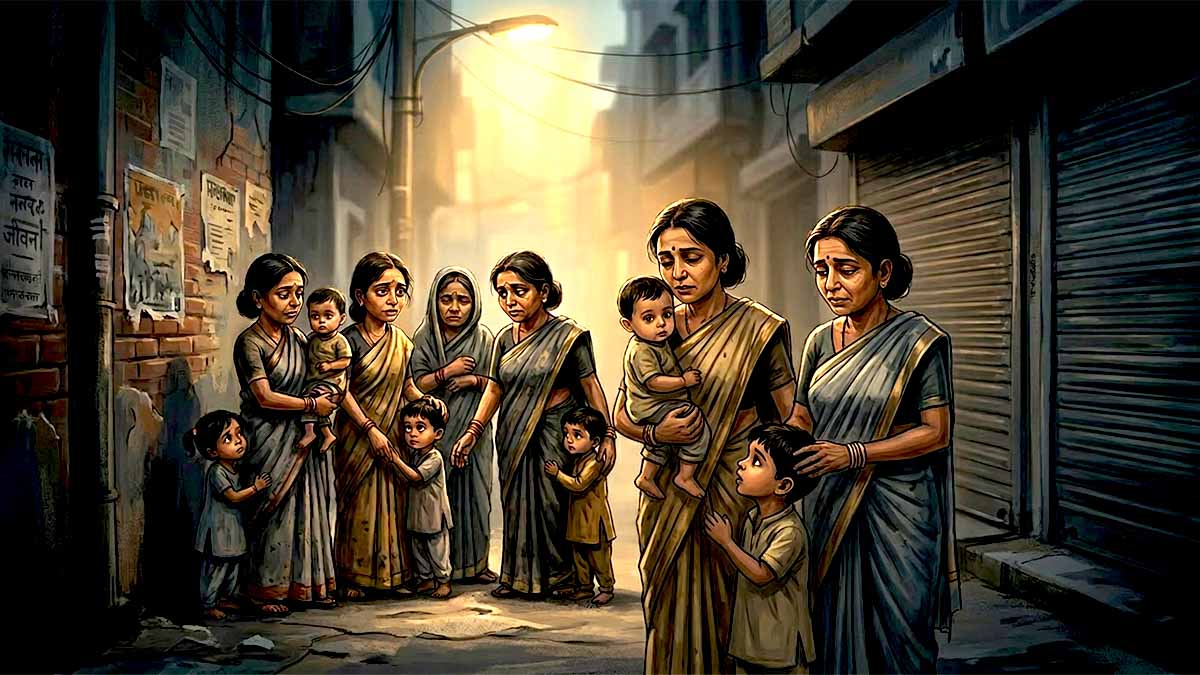
A tragic incident from Vasai near Mumbai has shaken the conscience of society, confronting us yet again with a reality of the morally degraded world that we live in.
A small 4-year old child, innocent and defenseless, became the victim of an act of brutality that momentarily stirred anger, grief, and a sense of collective demand for the harshest punishment for the perpetrator.
Yet, the sad reality remains that as the days pass that outrage against the heinous act begins to fade – and therein lies the deeper tragedy.
Vasai Child Attack: This is not an isolated incident
The incident in Vasai is not an exception – it is part of a disturbing pattern unfolding around us.
Recently, in Sangamner, a young teenage girl was attacked with acid while returning home from school, an act of cruelty that has left both physical and emotional scars.
Before this, in Malegaon, the brutal assault and murder of a three-year-old girl had shaken the conscience of society.
For days, there was grief, anger, and calls for justice – yet today, that incident too has faded from public memory.
The Cycle of Outrage and Forgetting
Each such tragic and brutal incident follows a familiar pattern. There is shock, followed by outrage, and an overwhelming flood of reactions.
For a brief moment, it feels as though society has awakened to the gravity of what has occurred, but gradually, silence takes over.
We react intensely, but briefly. We share, we comment, we condemn… and then we move on. The news cycle shifts, attention drifts, and what once felt unbearable slowly becomes distant.
A Society Growing Numb
Perhaps the most unsettling question we must confront is whether we are becoming desensitized to violence.
When brutality against children becomes just another headline, when even the most horrifying acts fail to hold our attention beyond a few days, it signals something deeper than a law-and-order issue.
It signals a crisis of compassion.
Children represent innocence in its purest form. They cannot defend themselves, nor can they comprehend the hatred directed toward them.
And yet, they are increasingly becoming victims of the darkest impulses of adults. This is not merely a failure of individuals – it is a reflection of a society losing its moral anchor.
Politicians and Protests
A lot of politicians, political parties, organisations and individuals keep protesting for all kinds of causes year along.
- Some for Language and Identity
- Some for Secularism
- Some for Hinduism
- Some protest against corruption
Yet when it comes to such tragic incidents, there is no one man enough to come forward in such times of need and to take up the responsibility of ensuring the severest punishment for the crime.
Why does this not become a central, unifying issue? Why is there no sustained, collective demand that transcends divisions? A society that can mobilize for everything – but not safety for its children – must pause and reflect.
No Fear of the Law
One of the most troubling aspects of such repeated incidents is the apparent absence of fear among perpetrators.
What emboldens such acts is not just anger or impulse, but also the perception that consequences are neither swift nor certain.
Investigations stretch on, trials take years or even decades, and public memory fades long before justice is delivered.
In that delay, a dangerous message is conveyed, that punishment is distant, uncertain, and a lot of times, avoidable.
Where Do These Cases Stand Today?
As public attention shifts, the status of these cases quietly recedes into the background.
In the Sangamner acid attack case, investigations continue as authorities attempt to identify and apprehend the accused, while the victim undergoes treatment and recovery.
The Malegaon case involving the three-year-old girl, once at the center of public outrage, has now moved into the long judicial process – no longer visible in daily discourse, yet far from resolved.
What Must Change
If such tragedies are to be prevented, not merely reacted to, there must be meaningful reform.
Fast-track courts for crimes against children, time-bound investigations, and strict, certain punishment are essential to establish real deterrence.
Justice must not only be delivered – it must be swift, visible, and decisive.
A Mirror to Ourselves
The incident in Vasai is not an isolated occurrence. It is a mirror reflecting uncomfortable truths of unchecked anger, fading empathy, and a society that reacts but does not sustain its resolve.
It is easy to feel outrage. It is far more difficult to remain engaged after the headlines fade. But unless we move from momentary reaction to sustained responsibility, nothing will change.
A society that cannot protect its children cannot call itself secure or civilized.