
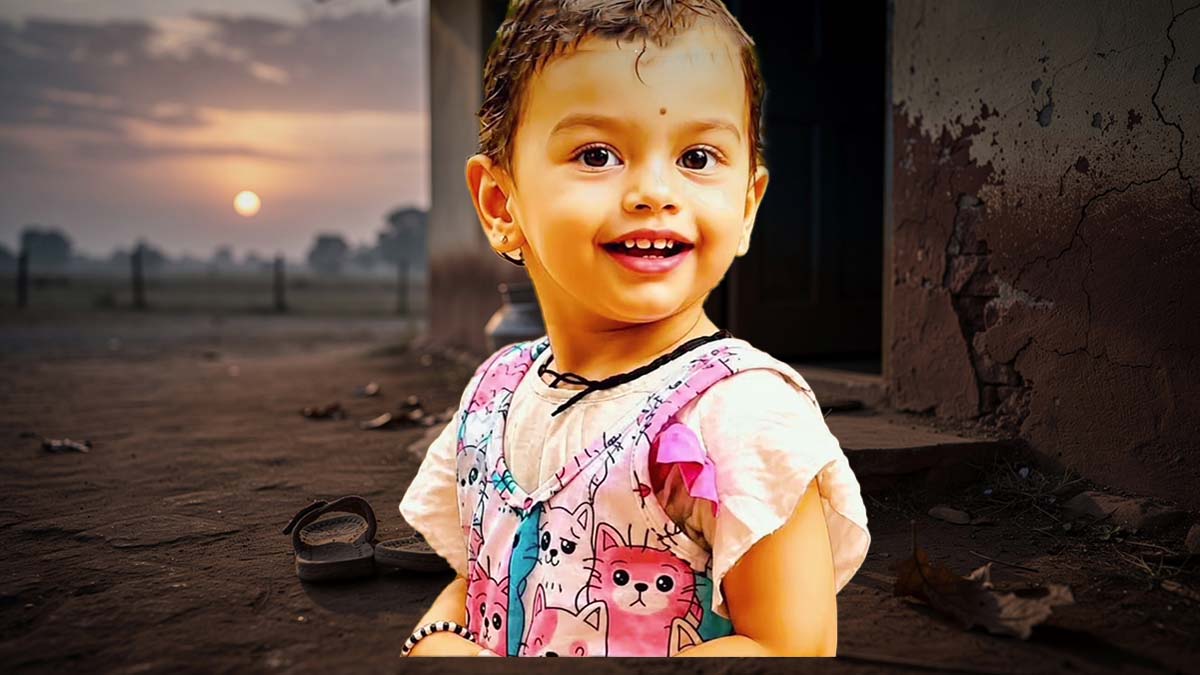
Once again our society finds itself confronting a reality it wishes it never had to face. From a quiet corner near Bhor taluka, in the village of Nasrapur, near Pune city, comes news that is not just disturbing, it is deeply unsettling.
A young child, barely four years old, subjected to an act so brutal that it shakes the very foundation of what we believe a society should stand for.
Voices rise, demands for justice echo, and again the same assurances are made. And yet, beneath all of this, there lingers a question that refuses to fade – why does this keep happening?
The Brutal Tragedy
The available CCTV footage shows moments that are difficult to process – a young girl child, innocent and trusting, walking with the accused, unaware of the horror that awaited her.
In a matter of moments, a life filled with laughter and play was extinguished in the most cruel and unimaginable way.
The same child who had been playing outside her home, full of life and joy, was later found in a condition that no human being should ever have to witness, let alone to be endured by a child.
What makes it even more unsettling is the bestial cruelty in the act itself. It is impossible to comprehend how someone could carry out such brutality without a moment of hesitation, without the slightest trace of remorse.
The child was found with her mouth stuffed with socks to muffle her cries and with severe wounds on her chest!
From a carefree happy child playing outside her house to a lifeless mass buried under a heap of cowdung, a life so mercilessly taken – leaves behind not just grief, but a deep, unsettling question about what is going wrong within us as a society.
When Will This Dreadful Pattern Change
This is not an isolated tragedy. Not long ago, Malegaon witnessed a similar heartbreaking tragedy involving a 3-year old child whose innocence was violated in the most horrific manner.
In Vasai, another such incident had left people shaken, with horrible scenes of the little kid being beaten violently, questioning the safety of even the most vulnerable among us.
Different places, different families, but the same unbearable grief. It begins to feel less like separate incidents and more like a pattern – one that society is yet to fully confront.
The Question of Law and Justice
In the immediate aftermath of such crimes, the response is almost predictable. The accused is apprehended, investigations begin, and the administration assures that the case will be handled with urgency.
Statements are made about swift justice, and once again, the term “fast-track court” enters public discourse. It sounds reassuring, almost like a promise that this time things will be different.
But what does this promise truly translate to on the ground? Does it mean justice within weeks, months, or years? And more importantly, does it create a sense of fear strong enough to prevent such crimes from happening again?
Certainly, it does not, hence such heinous crimes keep repeating.
India does not lack stringent laws when it comes to crimes against children. The POCSO Act was enacted with the clear intention of safeguarding minors and ensuring strict punishment for offenders.
Provisions exist, punishments are severe, and in certain cases, the law allows for the harshest penalties. And yet, the recurrence of such incidents forces us to confront an uncomfortable reality – that the existence of laws alone is not enough.
A law derives its strength not just from how strict it is, but from how swiftly and consistently it is enforced. When justice is delayed, when outcomes remain uncertain, the very deterrence that laws are meant to create begins to weaken.
What Happens After the Outrage Fades?
When the incidents in Malegaon and Vasai occurred, they too were met with outrage and assurances. There were calls for strict punishment, demands for accountability, and a collective sense that something must change.
But as time passes, these cases slowly recede from public attention. Few follow up on whether justice was delivered, whether the promised urgency translated into real outcomes.
And in that gradual fading, a dangerous pattern emerges, one where outrage is momentary, but the underlying issues remain unaddressed.
A Growing Sense of Helplessness
Perhaps what weighs most heavily is not just the crime itself, but the feeling it leaves behind. A quiet, unsettling sense that safety cannot be taken for granted.
That vulnerability exists even in places we assume to be secure. That systems respond, but rarely seem to prevent. This feeling, difficult to articulate yet impossible to ignore, slowly takes the shape of helplessness.
And when helplessness persists long enough, it risks turning into silent acceptance, a thought that is far more alarming than the crime itself.
It would be simplistic to place the entire burden on law enforcement alone. The reality is far more layered. The effectiveness of policing, the speed of judicial processes, the awareness within communities, and the vigilance exercised in everyday life, all of these together shape the environment in which such crimes either become possible or are prevented. Yet, at the centre of it all remains a fundamental expectation – that the law should not only punish, but also instil fear where it is necessary.
The Question That Remains
Another child has been lost. Another family has been left to endure a grief that words cannot capture. And once again, promises of justice have been made.
But unless something changes at a deeper level, unless enforcement becomes as strong as the law itself, unless accountability becomes consistent, unless society refuses to let these cases fade into memory, we risk returning to this same moment, again and again.