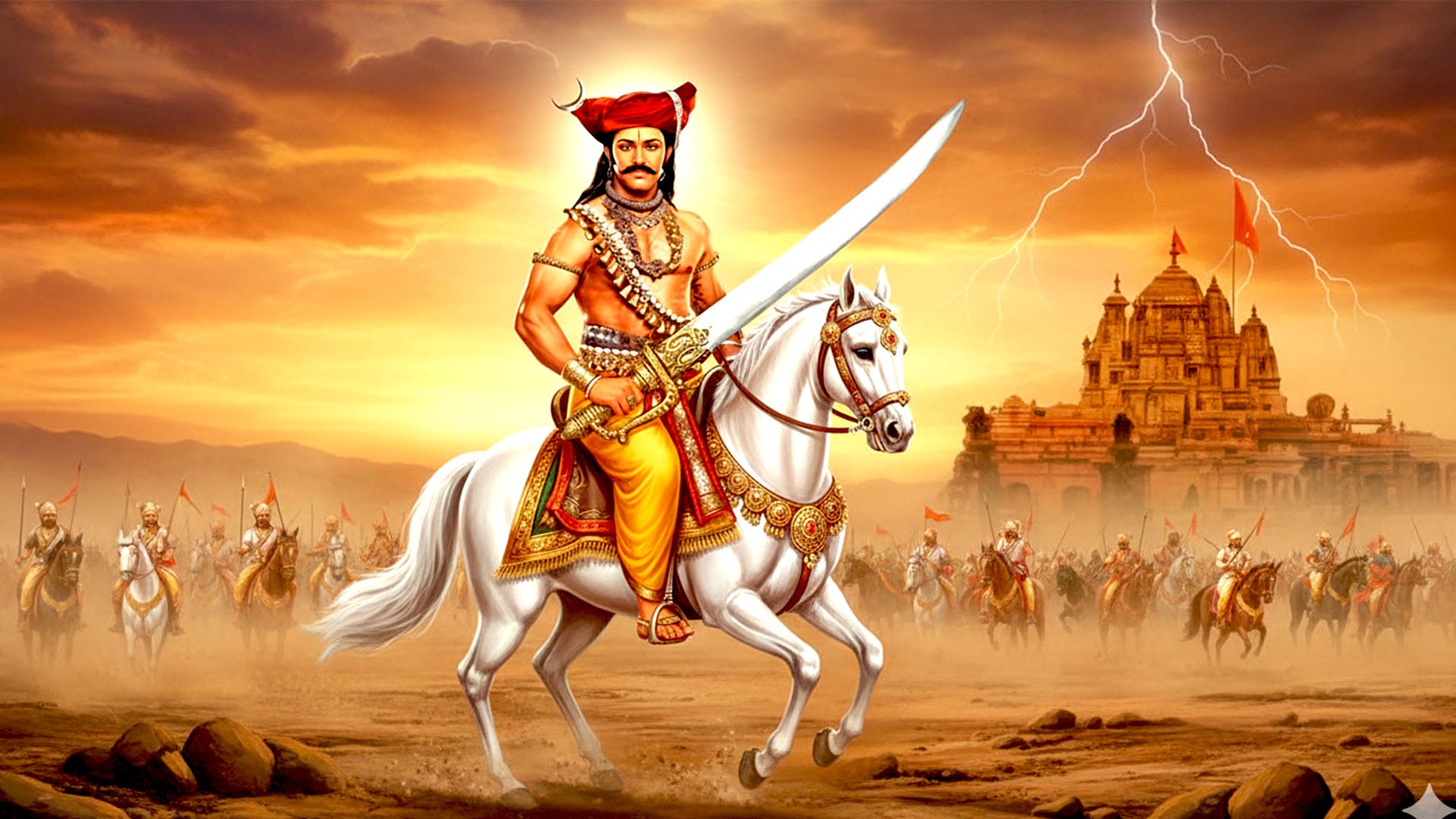
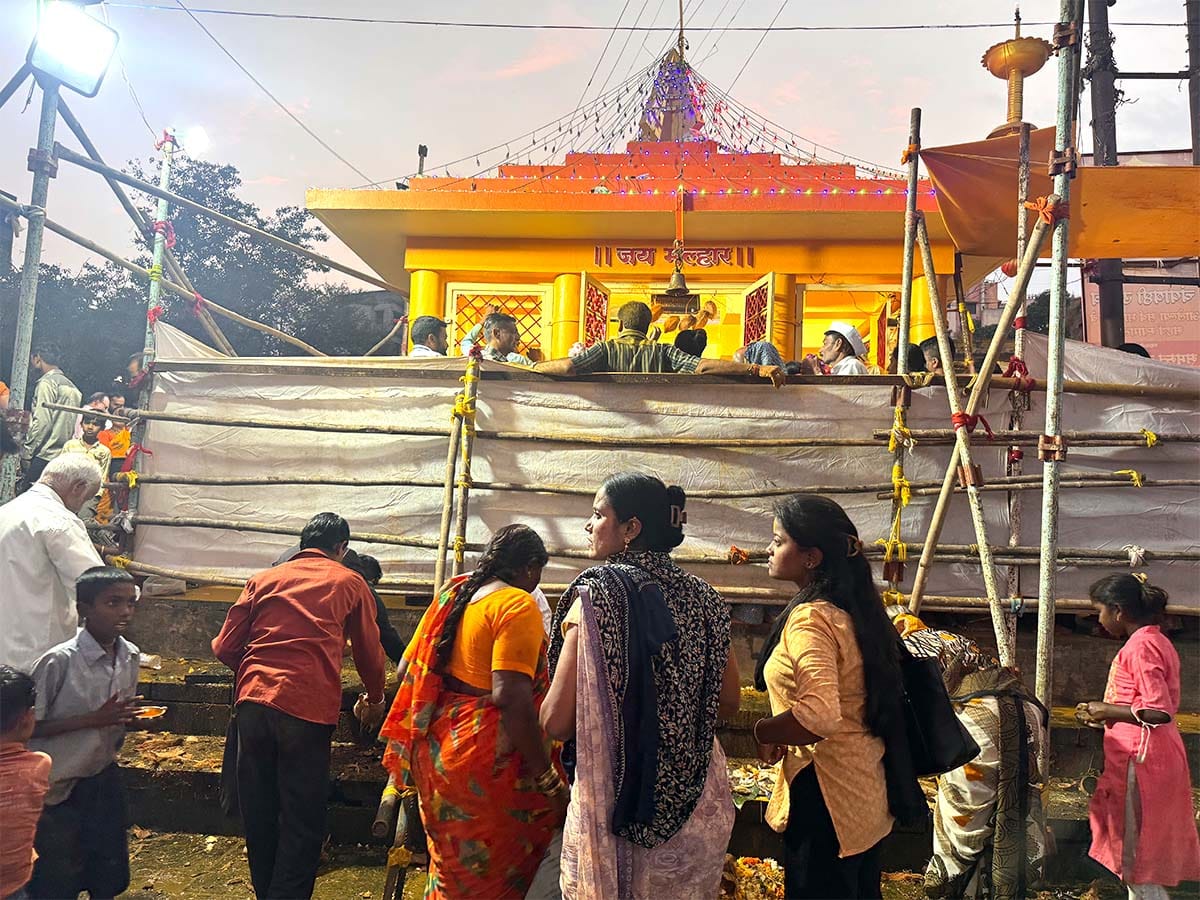
Champa Shashti, one of Maharashtra’s most important festivals dedicated to Khandoba (Malhari Martand), was celebrated on 26 November 2024 with immense devotion at the Khandoba Mandir on the banks of the Godavari in Panchavati, Nashik.
Though the grandest celebrations are traditionally associated with the Khandoba Temple Jejuri, Nashik’s riverfront version of this festival has an intimate, earthy, and culturally rich flavour that draws devotees from across the district every year.
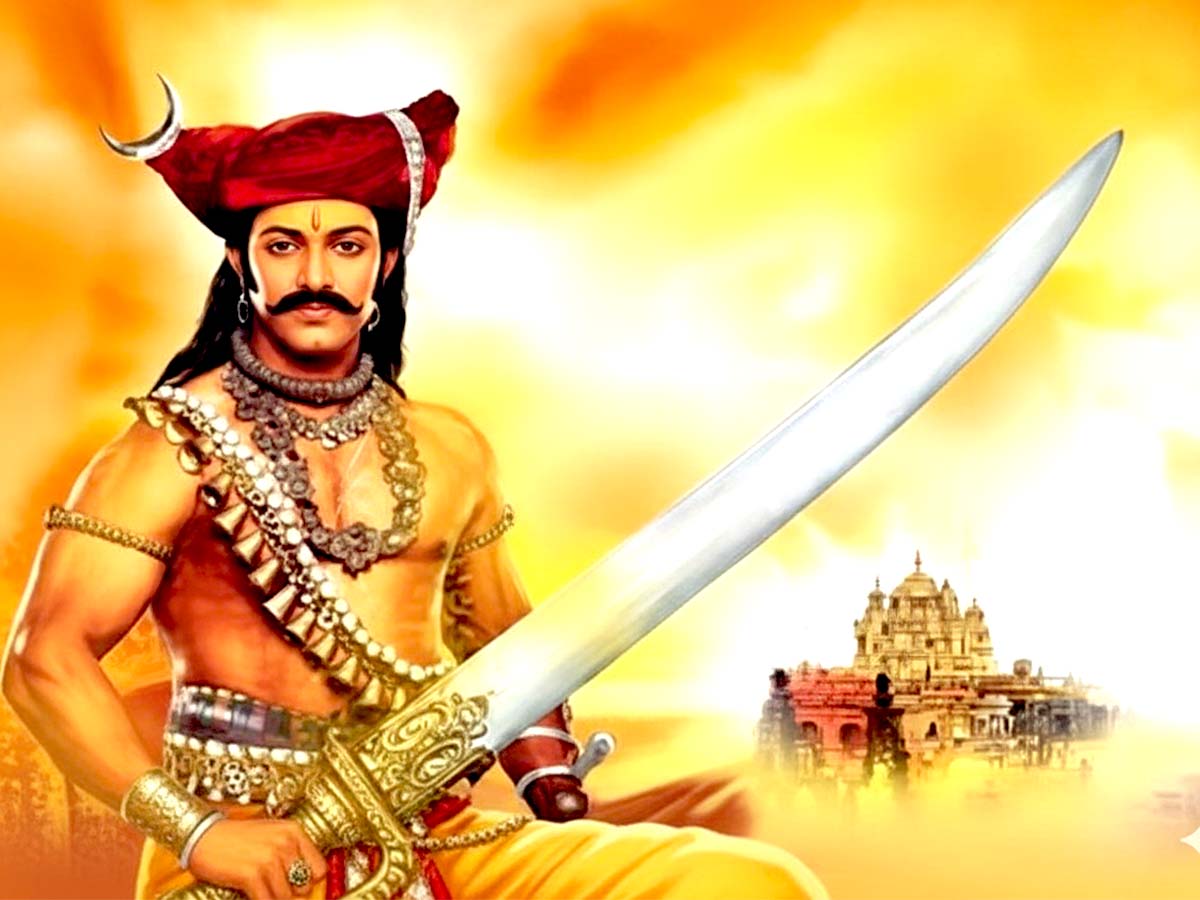
Khandoba: The warrior deity of Maharashtra
Worshipped widely across Maharashtra, Karnataka, Goa, Telangana and by communities such as the Dhangar community, farmers, pastoral tribes and rural families, Khandoba is seen as a form of Shiva who defeated the demons Malla and Mani.
Searches for “Khandoba God,” “Khandoba Photo,” “Khandoba Images,” “Khandoba Mandir,”and “Khandoba Aarti / Khandobachi Aarti” rise sharply around Champa Shashti, underscoring his deep cultural presence.
Legend also closely associates him with Mhalsa Devi (Mahalasa Narayani), whose temples – especially the Mahalasa Narayani Temple Goa – draw large pilgrim crowds. Many families in Nashik worship Khandoba along with his consort Mhalsa as their kuladaivat.
Who Is Mhalsa? The Principal Consort of Lord Khandoba
Among all the divine figures associated with Lord Khandoba, Mhalsa Devi – also known as Mahalasa, Mahalasa Narayani, or Mahalasa Devi of Goa – holds a place of unparalleled prominence.
In the tradition of Jejuri and in households across Maharashtra, Mhalsa is revered as the patta-patni, the lawful and principal wife of Khandoba, symbolising order, dharma, and the settled household life.
Her presence completes the divine duality of Khandoba’s worship, where Mhalsa represents discipline, structure, and royal dignity, while Banai represents spontaneity, courage, and pastoral freedom.
According to legend, Mhalsa is believed to be an incarnation of Parvati or Mohini, and her story begins in the region that is today associated with the famous Mahalasa Narayani Temple in Goa.
Devotees from across India visit the Goa temple, known for its tall samai, rich Konkani traditions, and unique rituals where Mhalsa is worshipped as a form of Shakti who destroys adharma.
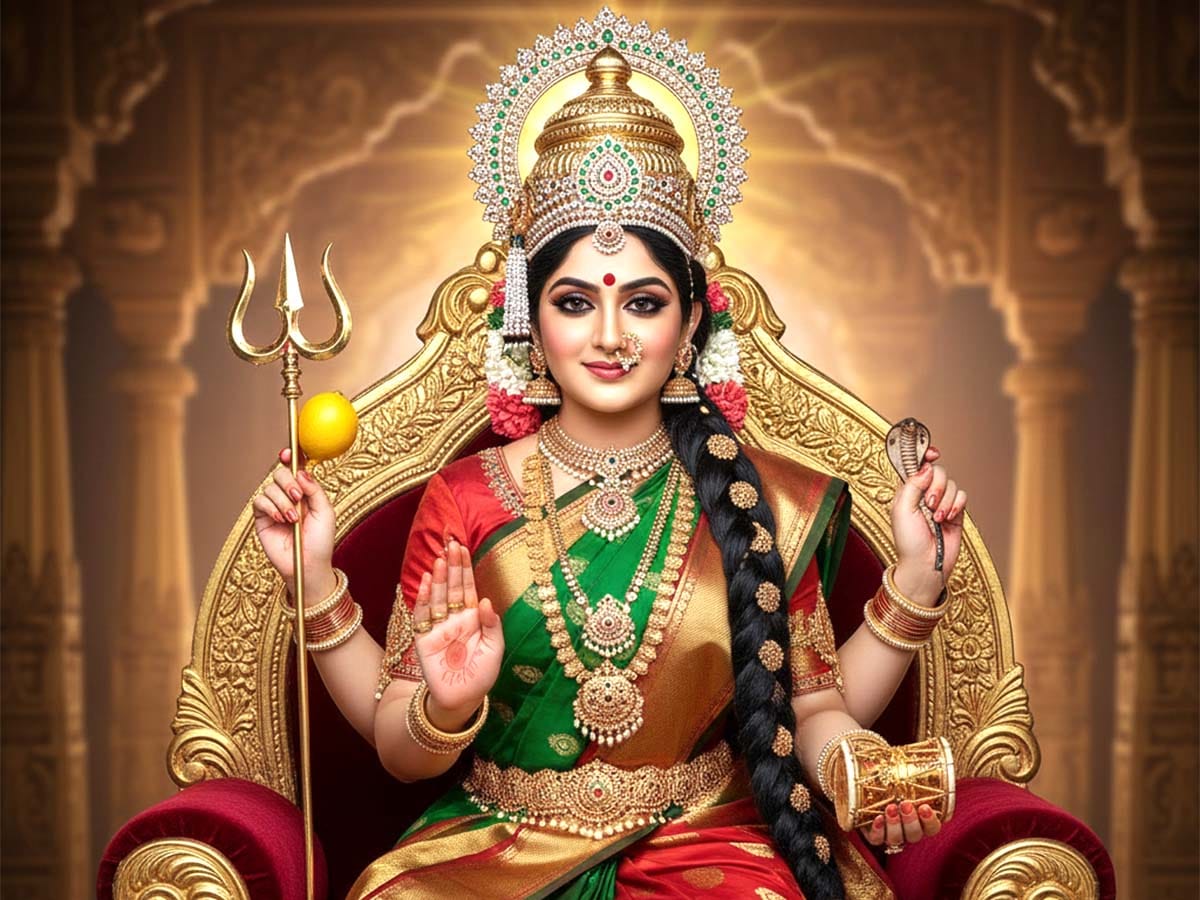
The popularity of terms like Mahalasa Narayani Goa, Mahalasa Narayani Temple Goa, and Mahalasa Devi in online searches reflects her widespread importance beyond Maharashtra.
In the Khandoba tradition, Mhalsa’s marriage to Khandoba or Khande Raya is celebrated with grandeur. Folklore describes how Khandoba, appearing as a radiant warrior riding his white horse, visited her home and asked for her hand.
Her father consented after recognising the divine signs surrounding the proposal, and the wedding was celebrated with royal splendour.
This sacred union established Mhalsa as the Grihalakshmi of Khandoba’s household – symbol of marital fidelity, auspiciousness, and domestic order. Because of this role, many families in Maharashtra invoke Mhalsa Devi during weddings, housewarming ceremonies, and major rites of passage.
In contrast to Banai, who comes from the Dhangar community, Mhalsa is associated with a highly refined, orthodox ritual identity. Where Banai symbolises nature, resilience, and pastoral culture, Mhalsa embodies civilisation, royalty, purity, and ritual correctness.
This duality – Banai’s rustic devotion and Mhalsa’s regal discipline – is at the heart of Khandoba’s greatly loved “two-queen tradition.” Devotees see the two not as rivals, but as two dimensions of divine womanhood, two expressions of Shakti that complete the cosmic identity of Khandoba.
At Jejuri’s Khandoba temple, where lakhs of devotees gather especially during Champa Shashti, Mhalsa’s presence is felt in every ritual. Her aarti, her decorated idols, and her importance in marriage symbolism reflect her deep integration into the Malhari tradition.
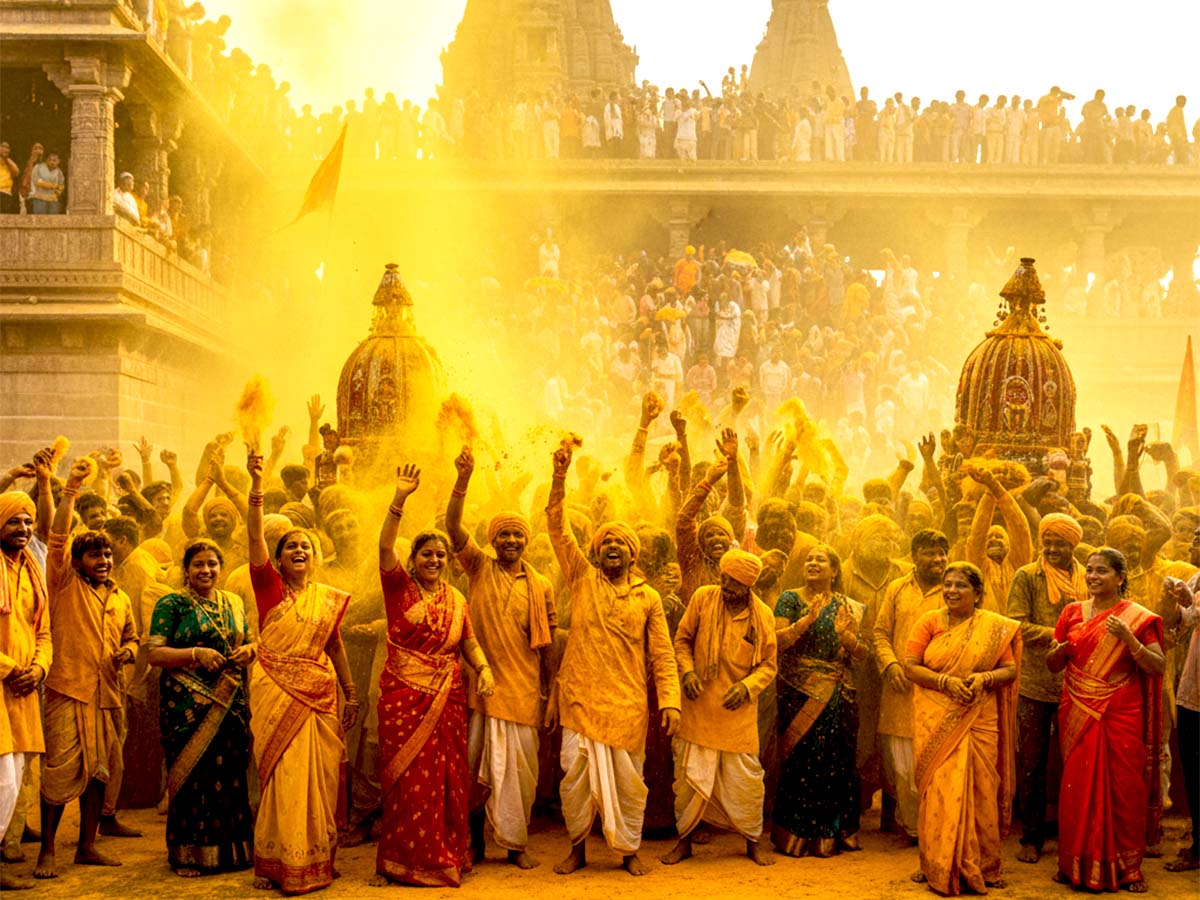
Even during the explosive celebration of bhandara – the clouds of turmeric that cover Jejuri – devotees call out both names with reverence.
Thus, Mhalsa Devi is not just the first wife of Khandoba – she is the embodiment of grace, dharma, Shakti, and divine order.
Her story enriches the narrative of Maharashtra’s most dynamic folk deity and brings together the spiritual heritage of Jejuri, Goa, and countless families who worship her with devotion.
Banai (Banu Bai): The Beloved Shepherdess and Second Wife of Khandoba
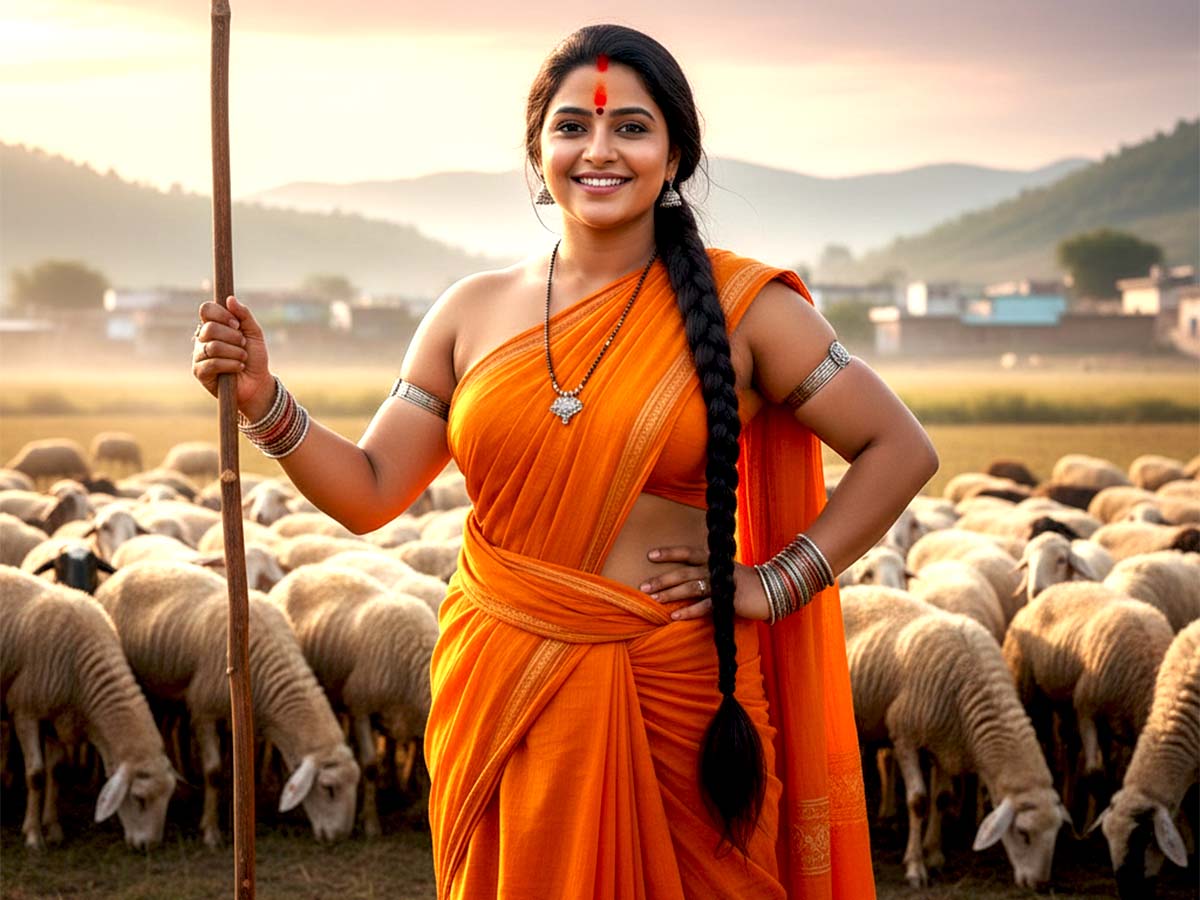
Banu Bai, also lovingly called Banai – the pastoral goddess is revered as the second wife of Lord Khandoba.
While Mhalsa represents the royal and ritualistic aspect of Khandoba worship, Banai embodies the folk, pastoral and earth-centred devotion of rural Maharashtra.
According to tradition, Banai was born into the Dhangar (shepherd) community, and her story reflects the deep bond between Khandoba and the pastoral tribes of the Deccan.
Legends narrate that Khandoba first encountered Banai while she was herding sheep and goats in the vast grasslands of the Western Ghats. Their union is considered symbolic of the harmony between nature, pastoral life, and divine grace.
Even today, the Dhangar community regards Banai as their kuladevi (ancestral goddess) and celebrates her marriage to Khandoba with unique rituals involving folk songs, godhonis, and beautifully performed Dhangari Gaja dance.
In contrast to the grandeur and lamp-lit rituals of Jejuri, Banai’s shrines remain simple, often located in rural hilltops or forest edges – preserving the raw, earthy spirit of Dhangar life.
Many devotees believe that Banai brings prosperity to livestock, protection during migrations, good monsoons, and abundance in grazing lands.
This duality of Mhalsa and Banai – the royal and the pastoral – reflects Khandoba’s role as a deity of all people, uniting castes, communities, and lifestyles across Maharashtra and Karnataka.
Banai-Mhalsa Dynamics in Khandoba Tradition
One of the most fascinating aspects of Khandoba worship is the duality between his two consorts – Mhalsa and Banai – which reflects Maharashtra’s social, cultural, and regional complexity.
Mhalsa, born as the incarnation of Mohini, is the patrani (principal queen). She represents order, ritual purity, and the established norms of temple worship.
Her temples — especially at Jejuri — are organised, structured, and associated with brahmanical traditions, yajnas, and classical music. She embodies discipline, devotion, and righteous authority.
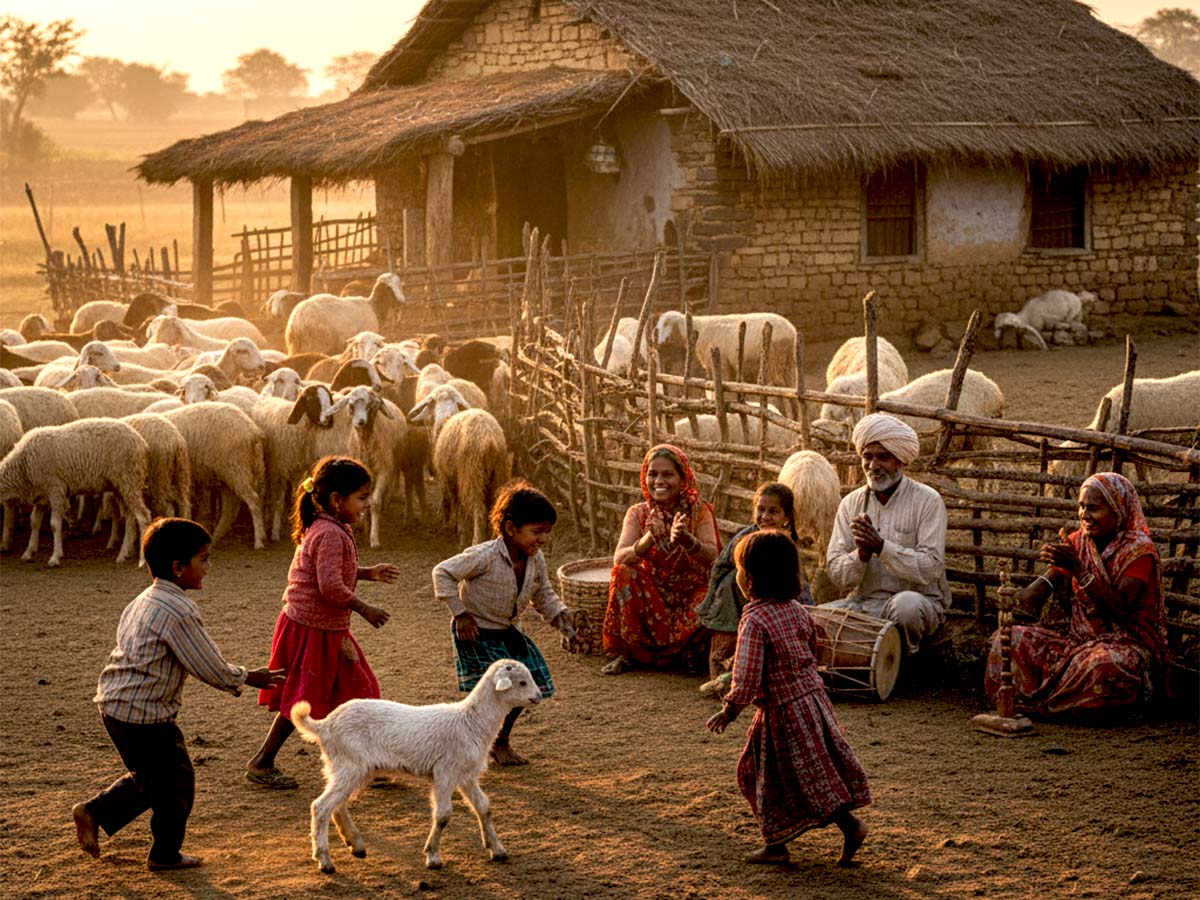
Banai (Banu Bai), on the other hand, is the pastoral, free-spirited goddess of the Dhangar (shepherd) community. She represents nature, spontaneity, and the unpolished yet powerful devotion of the rural Deccan.
Banai’s shrines are simple, often located in grazing lands, hilltops, or open-air setups where herdsmen offer curd, sheep wool, and millet instead of traditional puja items. She symbolizes fertility, protection of livestock, and the rhythms of nomadic life.
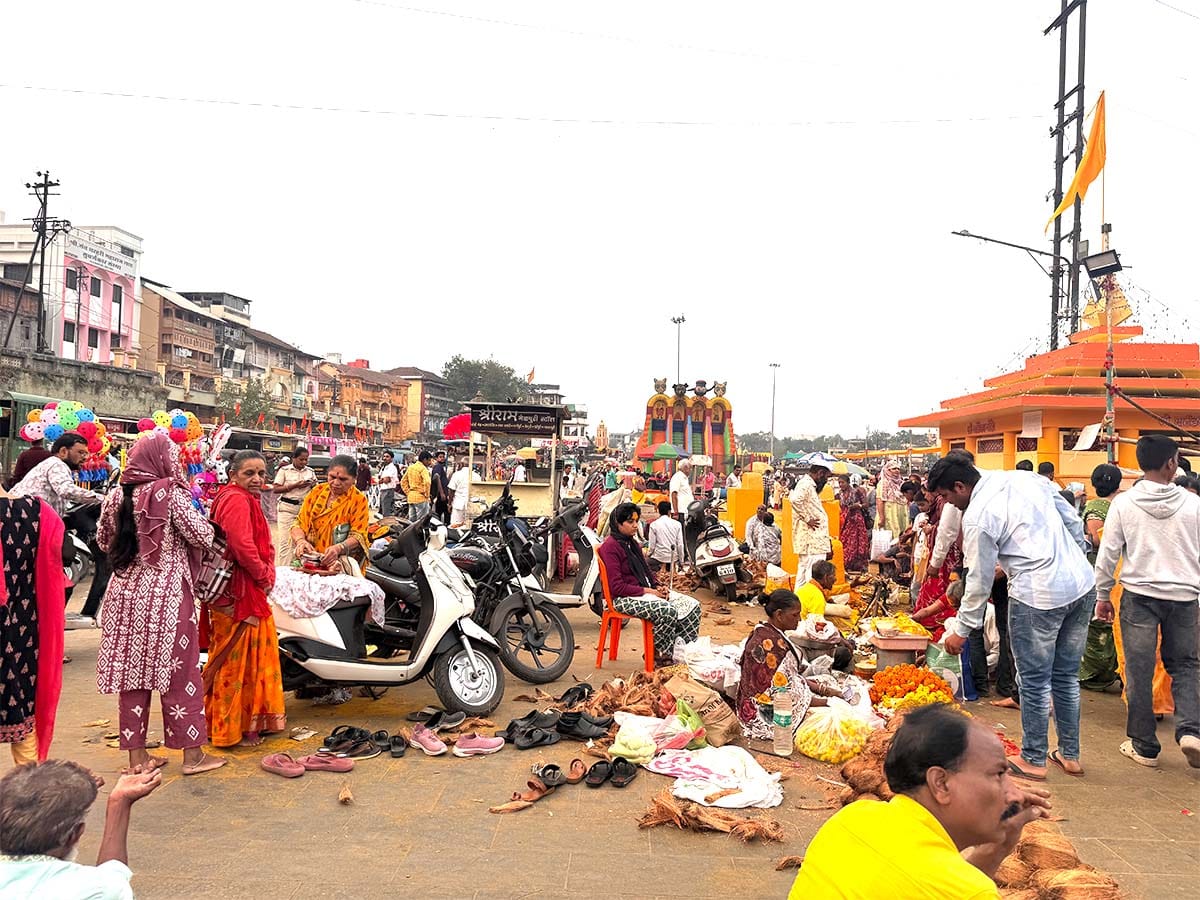
A Festival Rooted in Maharashtra’s Bhakti and Rural Traditions
While lakhs of devotees travel to the famous Khandoba Temple Jejuri, often arriving via the Jejuri Railway Station, Nashik’s Champa Shashti has its own identity.
Here the rituals, chants, and ambience reflect the Panchavati influence, blending the Ramayana heritage with Marathi rural faith traditions.
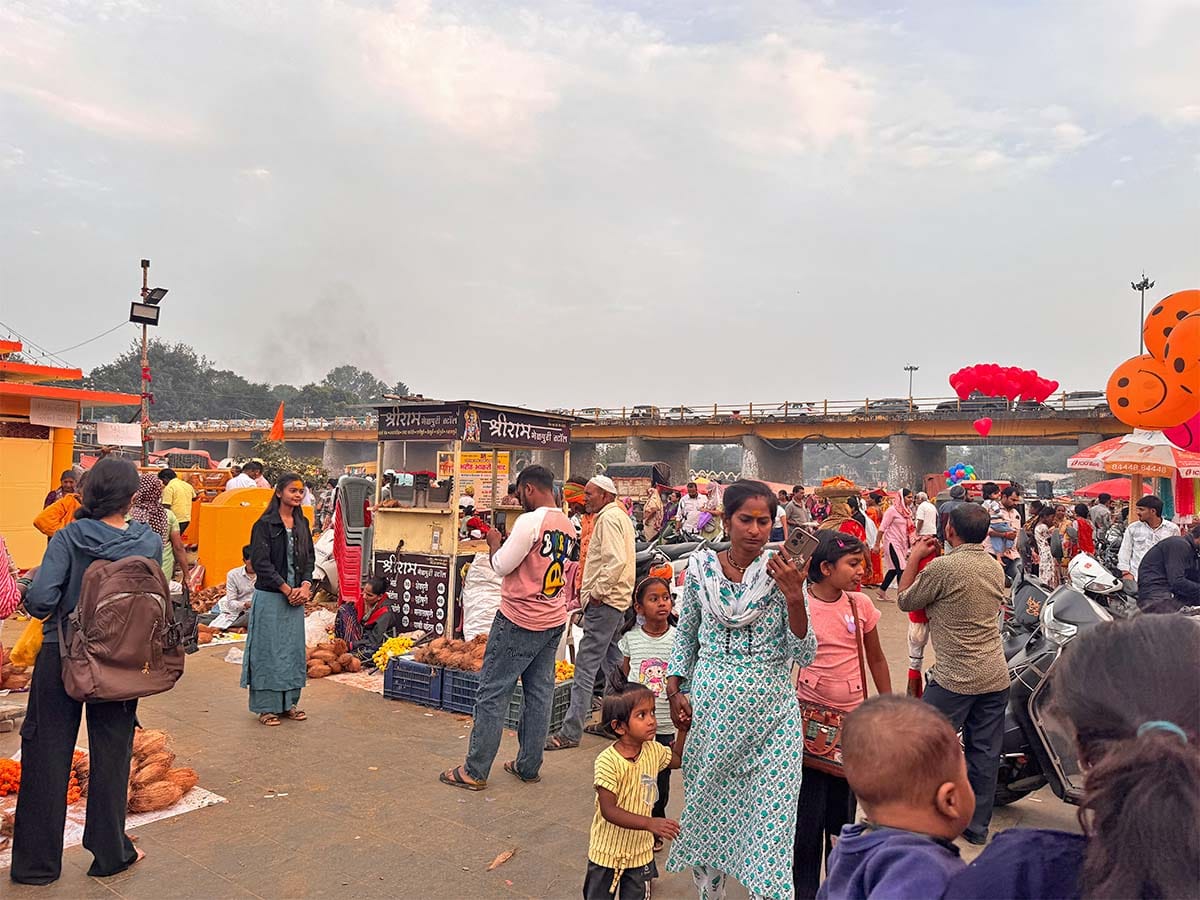
The Atmosphere at Panchavati – A Living Festival
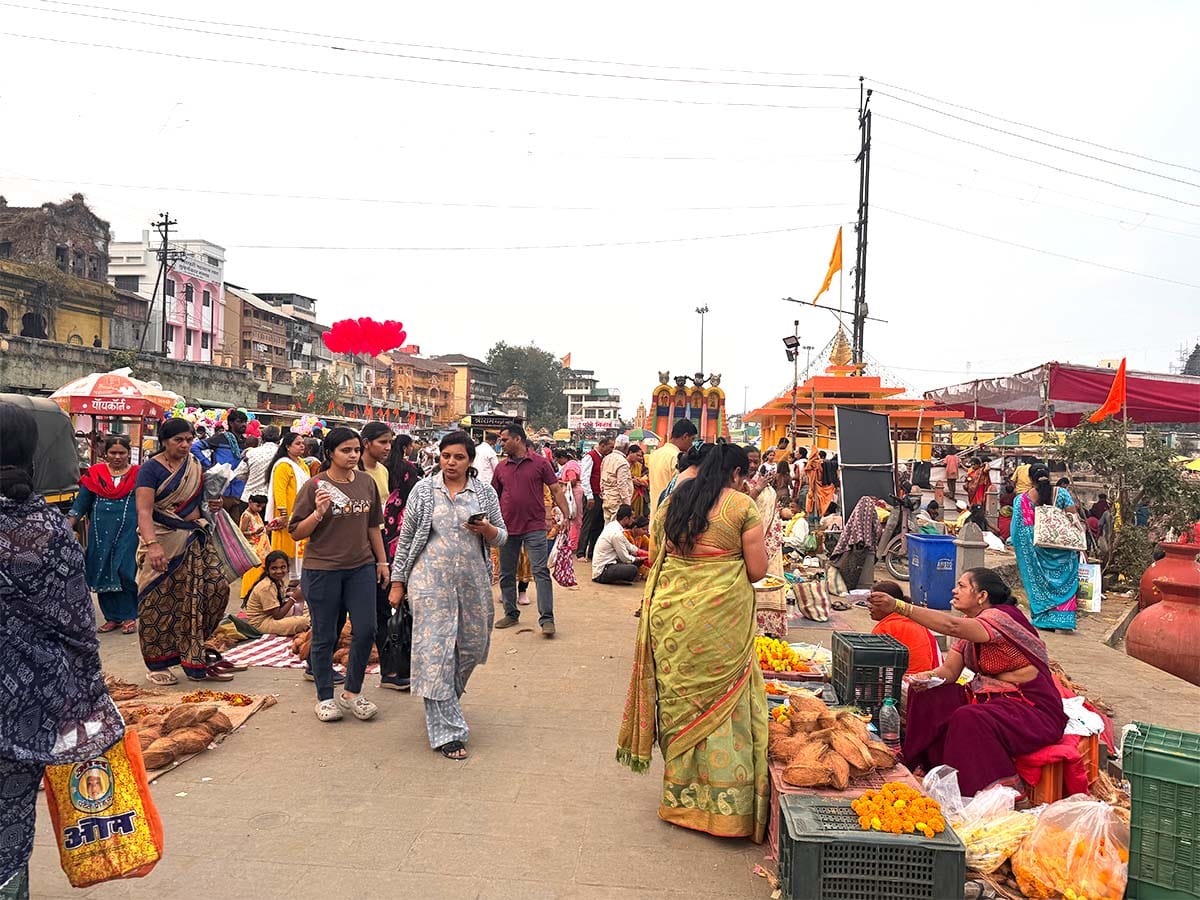
By afternoon, the entire stretch around Ganga Ghat – Gadge Maharaj Pool transformed into a vibrant, sacred corridor. Families gathered with coconuts, turmeric, bel leaves, bananas and flowers.
The smell of haldi, incense, river air and food stalls combined into a nostalgic, unmistakably Marathi festival mood.
Tali Bharne – A Ritual that Lights Up the Ghats
Dozens of devotees and priests sat in neat rows performing the traditional ritual of tali bharne – filling a metal plate with turmeric (bhandara), flowers, bel leaves and a symbolic representation of Khandoba’s sword.
Yelkot Yelkot Jai Malhar!
Throughout the day, the ghats echoed with the powerful chants:
“येळकोट येळकोट जय मल्हार!”
“सदानंदाचा येळकोट!”
These chants, associated with the Marathi warrior tradition and the Khandoba faith, carried through the roads, markets and riverfront, creating an atmosphere that felt ancient yet lively.
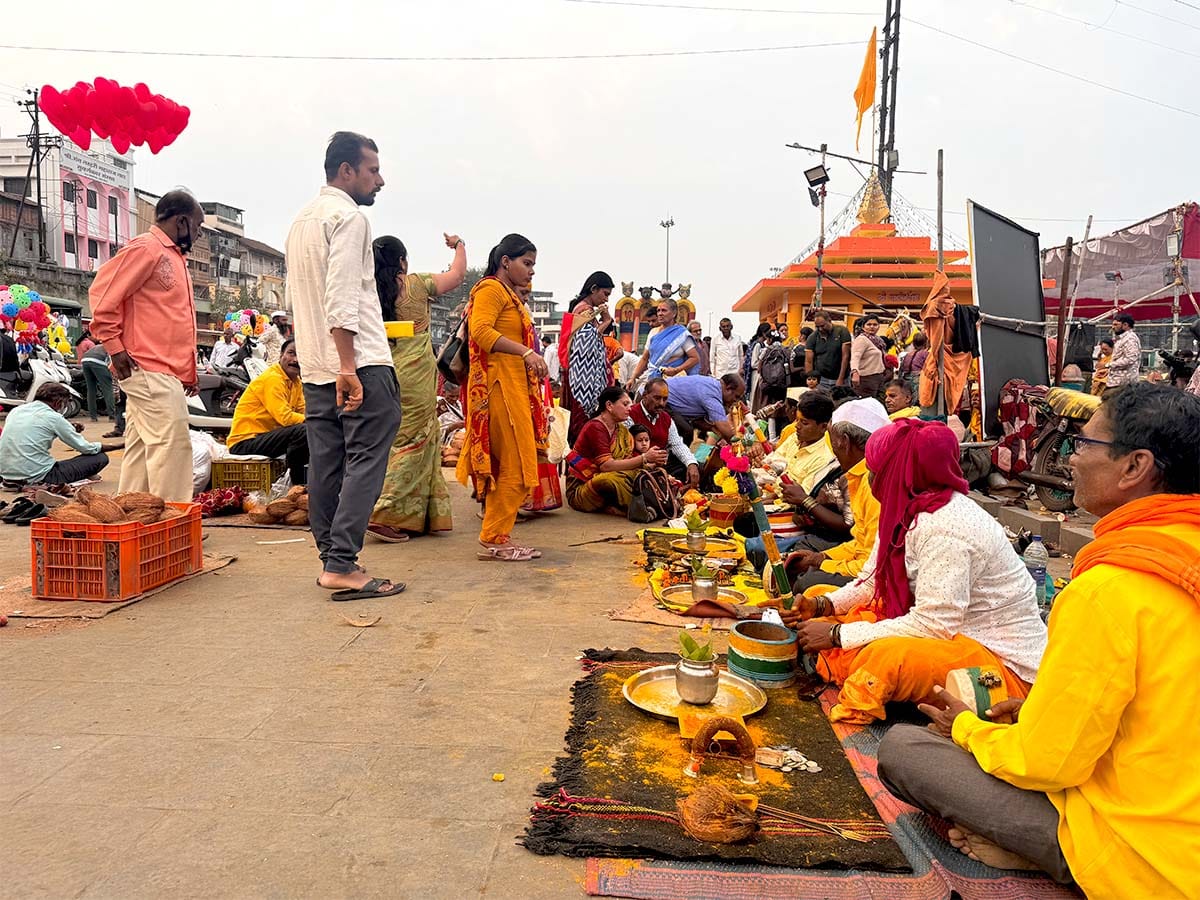
Bhandara: The Sacred Yellow Dust
The holy bhandara (turmeric powder), synonymous with Khandoba worship, covered the stairs, pathways and even the clothes of devotees.
This yellow cloud of devotion is what connects the festival spiritually to Jejuri – famous worldwide for its turmeric-laden celebration.
Market Life and Family Festivity
Balloons sellers, coconut vendors, toy sellers and small eateries turned the whole area into a fairground – a reminder that festivals are not only spiritual but also moments of livelihood and joy for Nashik’s working families.
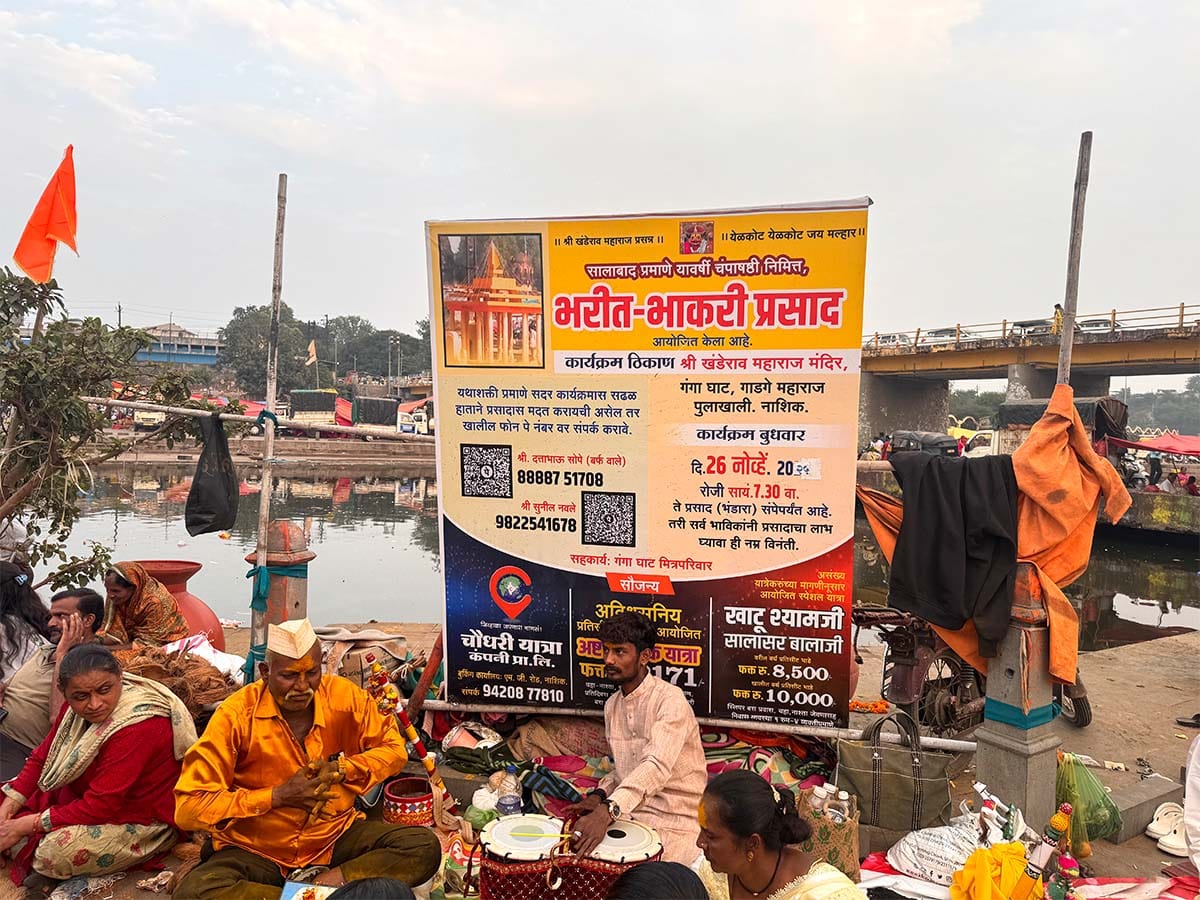
Special Mahaprasad : Bharit and Bhakri
A huge banner near the temple announced the Bharit-Bhakri Prasad distribution –Vangyache Bharit (smoky roasted brinjal) paired with Bajri Bhakri, a classic rural Maharashtrian combination deeply associated with Khandoba. Devotees queued patiently as volunteers served with warmth.
Evening Darshan
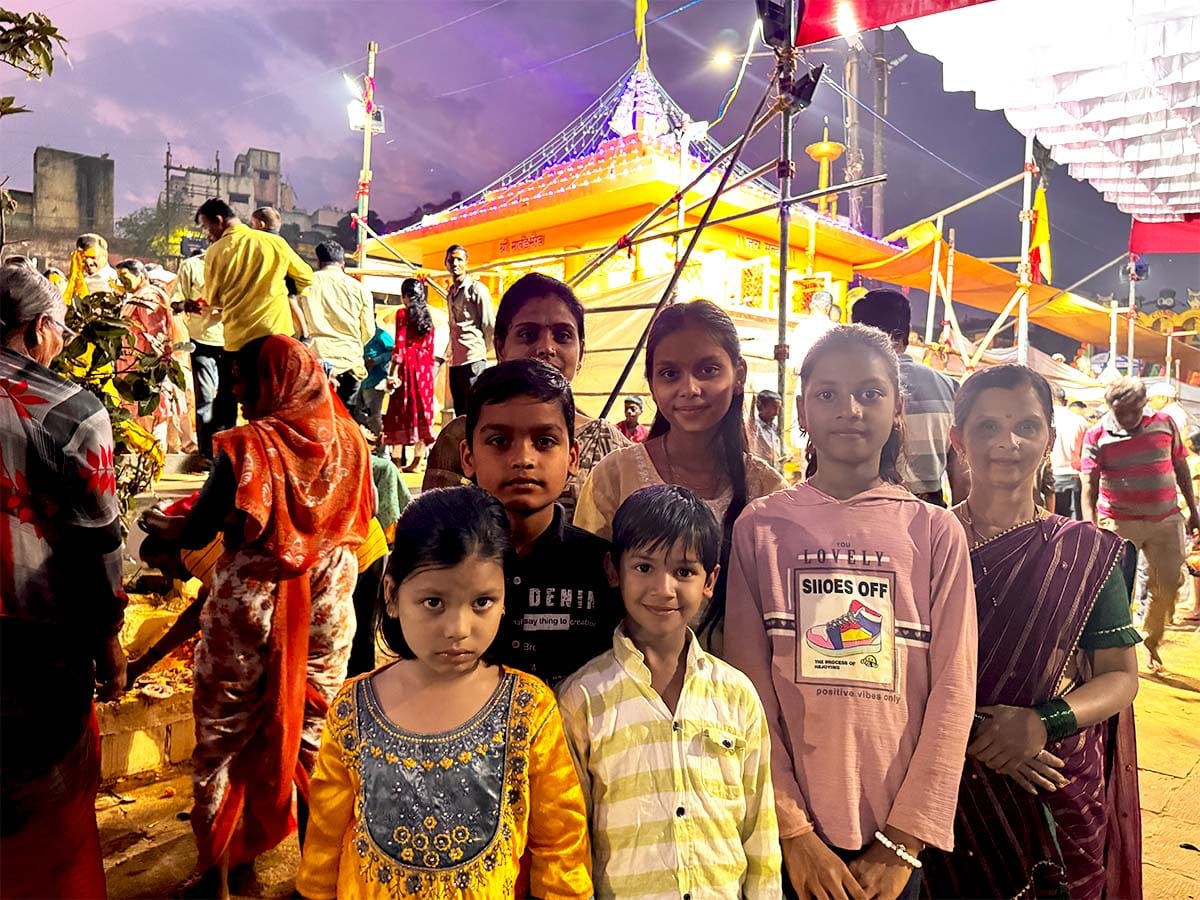
As dusk approached, lights around the Khandoba temple illuminated the surroundings. Devotees climbed the stone steps with offerings, while the chants and drums grew louder.
The river reflected the glow of the temple, making it one of the most magical devotional scenes in Nashik during the winter season.
Why Champa Shashti in Nashik Is Special
- The festival unfolds along the sacred Godavari, giving a unique spiritual backdrop not seen elsewhere.
- Panchavati’s Ramayana heritage blends beautifully with the worship of Khandoba, a deity rooted in Maharashtra’s rural and warrior culture.
- The festival retains a raw, unfiltered, traditional flavour – no commercialisation, just pure devotion.
- Communities from Ahilyanagar, Solapur, Marathwada, Jalgaon, Dhule and Nashik’s rural belt participate, making it a cultural melting pot.
Related
FAQ
What is Champa Shashti?
Champa Shashti is a major festival dedicated to Khandoba, celebrated mainly in Maharashtra. Devotees worship Khandoba as the destroyer of evil, and rituals such as tali bharne, coconut offerings, and chanting “Yelkot Yelkot Jai Malhar” are performed. Many people search for Champa Shashti to know the exact date, its importance, and puja procedures.
Who is Khandoba?
Khandoba is considered a warrior form of Shiva and the Kuldaivat of many communities. Searches like Khandoba god, Khandoba photo, Khandoba images, and Khandobachi gane show his widespread popularity. He is mainly worshipped at Jejuri, known as Sonyachi Jejuri for its golden bhandara.
Where is the main Khandoba temple located?
The most famous shrine is the Khandoba Temple, Jejuri, attracting pilgrims from across India. Queries like Khandoba mandir, Jejuri Khandoba, Khandoba temple Jejuri photos, and Khandoba temple consistently rank among the highest searches. The temple is known for steep steps, vibrant turmeric rituals, and daily Khandoba aarti.
How to reach Jejuri Khandoba Temple?
Devotees can reach through the well-connected Jejuri Railway Station, one of the most searched travel terms linked to the deity. Regular trains operate from Pune, Satara, and Solapur, making it convenient for pilgrims.
Who is Mhalsa Devi (Mahalasa)?
Mhalsa, also known as Mahalasa Narayani, is Khandoba’s first wife and is worshipped as a powerful form of Goddess Durga. Queries such as Mhalsa Devi, Mahalasa, Mahalasa Narayani, and Mahalasa Narayani Goa indicate strong devotional interest. Her major temple at Mardol is searched as Mahalasa Narayani Temple Goa.
Who is Banai, the second wife of Khandoba?
Banai (or Banu Bai) belongs to the Dhangar shepherd community and is deeply revered in rural Maharashtra. Searches like Dhangar and Dhangar caste often connect to Banai’s traditions. Her marriage story with Khandoba is central to folk culture, music, and Champa Shashti rituals.
What is special about Khandoba worship in Nashik?
At Nashik’s Khandoba temple on the Godavari in Panchavati, devotees participate in tali bharne, bhandara rituals, and prasad distribution. Many come looking for Khandoba aarti, Khandobachi Aarti, and festival photos, especially on Champa Shashti.
Why is Jejuri famous for Khandoba aarti?
The Khandoba Aarti at Jejuri is a major attraction, where devotees sing traditional Khandobachi gane amidst clouds of golden turmeric. Many visitors use keywords like Khandoba aarti and Khandoba temple Jejuri photos before planning their trip.
What prasad is offered during Champa Shashti?
A traditional meal of vangyache bharit and bajri bhakri is served as prasad at many temples. In Nashik, special arrangements are made every year near the riverbanks where devotees gather in huge numbers.
Is photography allowed at Khandoba temples?
Most outdoor temple areas allow photography. This is why devotees often search for Khandoba photo, Khandoba images, and Jejuri Khandoba before visiting.